

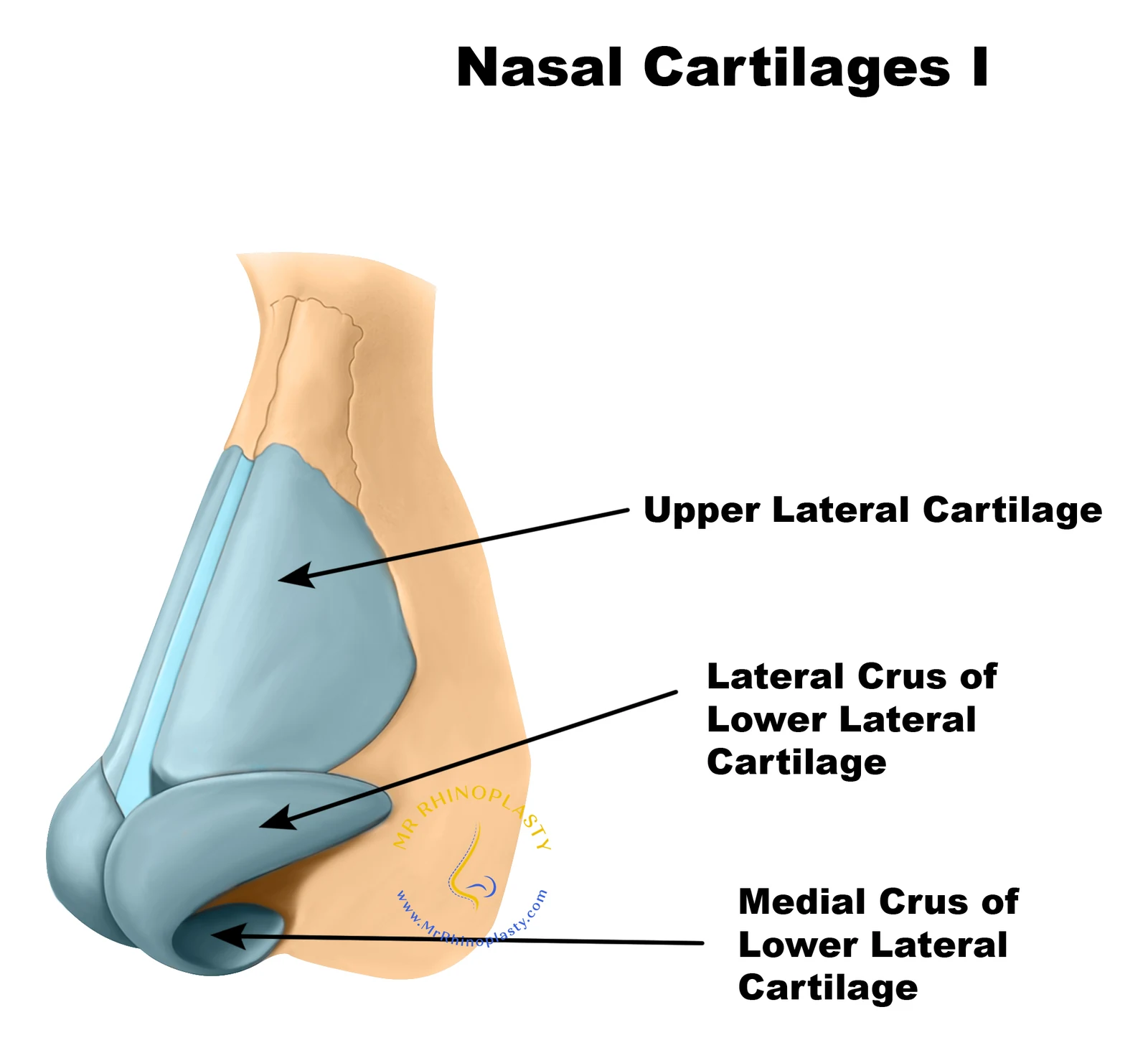
Older rhinoplasty techniques relied mainly on removing bone and cartilage, which could weaken the nose and lead to collapse or breathing problems years later. Structural rhinoplasty takes the opposite approach: it reinforces the framework of the nose with cartilage grafts, so the new shape is supported and stays stable as the nose heals and ages.
The Framework of the Nose
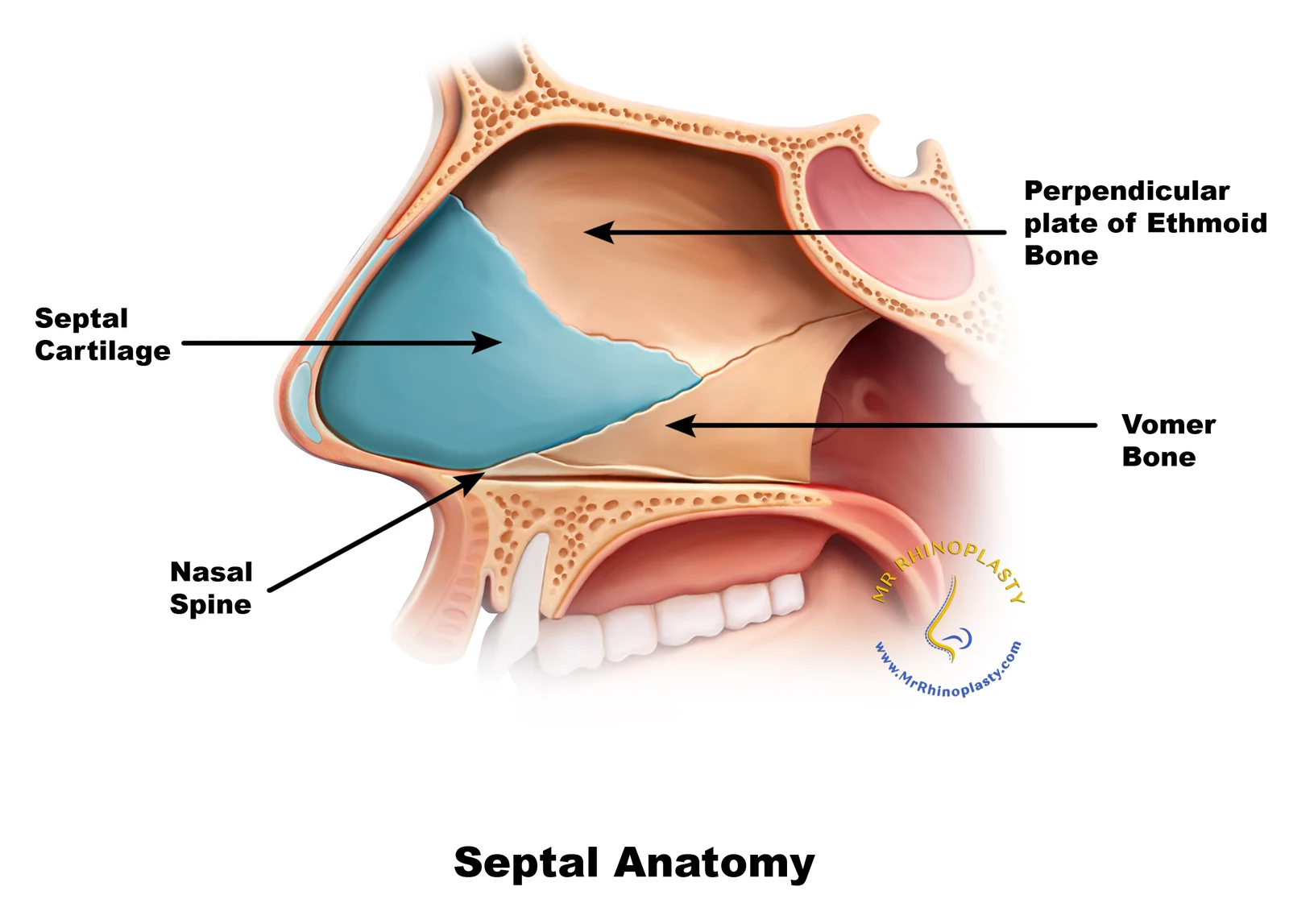
The shape of the nose is held up by bone in the upper third and cartilage in the middle and lower parts, with the septum acting as the central support. When any part of this framework is weak, bent or missing, the nose can look pinched, twisted or collapsed, and the airway can narrow. See Anatomy of the Nose.
When Is Structural Rhinoplasty Needed?
Structural techniques are used whenever the nose needs its support rebuilt rather than tissue removed, for example:
Revision surgery
When a previous operation has removed too much cartilage or left the nose unsupported.
Saddle nose
A dip in the bridge caused by loss of septal support after injury or surgery.
Pinched or collapsed tip
Weak lower cartilages that give a pinched look or collapse when breathing in.
Nasal valve collapse
Narrowing at the sides of the nose that blocks breathing, especially on exertion.
Injury
A nose that has lost its shape or support after trauma.
See Risks & Revision, Saddle Nose and Nasal Valve Collapse.
Where Does the Graft Cartilage Come From?
Wherever possible, cartilage is taken from the septum. When this has already been used, or there isn’t enough remaining, cartilage is harvested from the ear or the rib. Rib cartilage provides a robust source of graft material for complex structural reconstruction, particularly in patients who have undergone multiple previous procedures.
Septum
Usually the first choice, taken from inside the nose during the same operation.
Ear
Curved cartilage from the ear, useful for shaping and supporting the tip.
Rib
A larger, stronger source for major reconstruction. Cadaveric rib cartilage (human tissue) is an alternative option.
How Is Structural Rhinoplasty Performed?
Structural rhinoplasty is usually carried out through an open approach, with a small incision across the columella, so the framework can be seen and rebuilt accurately. Grafts are shaped and secured to strengthen the septum, support the tip, rebuild the bridge or hold the nasal valves open. The operation is performed under general anaesthetic and usually takes longer than a standard rhinoplasty.
Complex Reconstruction
In the most complex cases - where the nose has lost significant structural support, or where multiple previous operations have left limited native cartilage - rhinoplasty becomes a reconstructive procedure in its own right, rebuilding the framework of the nose from the inside out before any cosmetic refinement can be considered.
Recovery After Structural Rhinoplasty
Recovery is similar to other rhinoplasty, with swelling and bruising for the first couple of weeks and a splint for around a week. If rib cartilage is used, there is also a small scar on the chest and some discomfort there while it heals. Swelling takes longer to settle after complex reconstruction, and the final result can take a year or more to show. See The Patient Journey for what to expect at each stage.
Mr Patel is a Consultant ENT Surgeon, so your breathing and the appearance of your nose are assessed together at every consultation.
Has Your Nose Lost Its Support?
To find out whether structural rhinoplasty could help, book a consultation with Mr Patel at 51 Harley Street.