

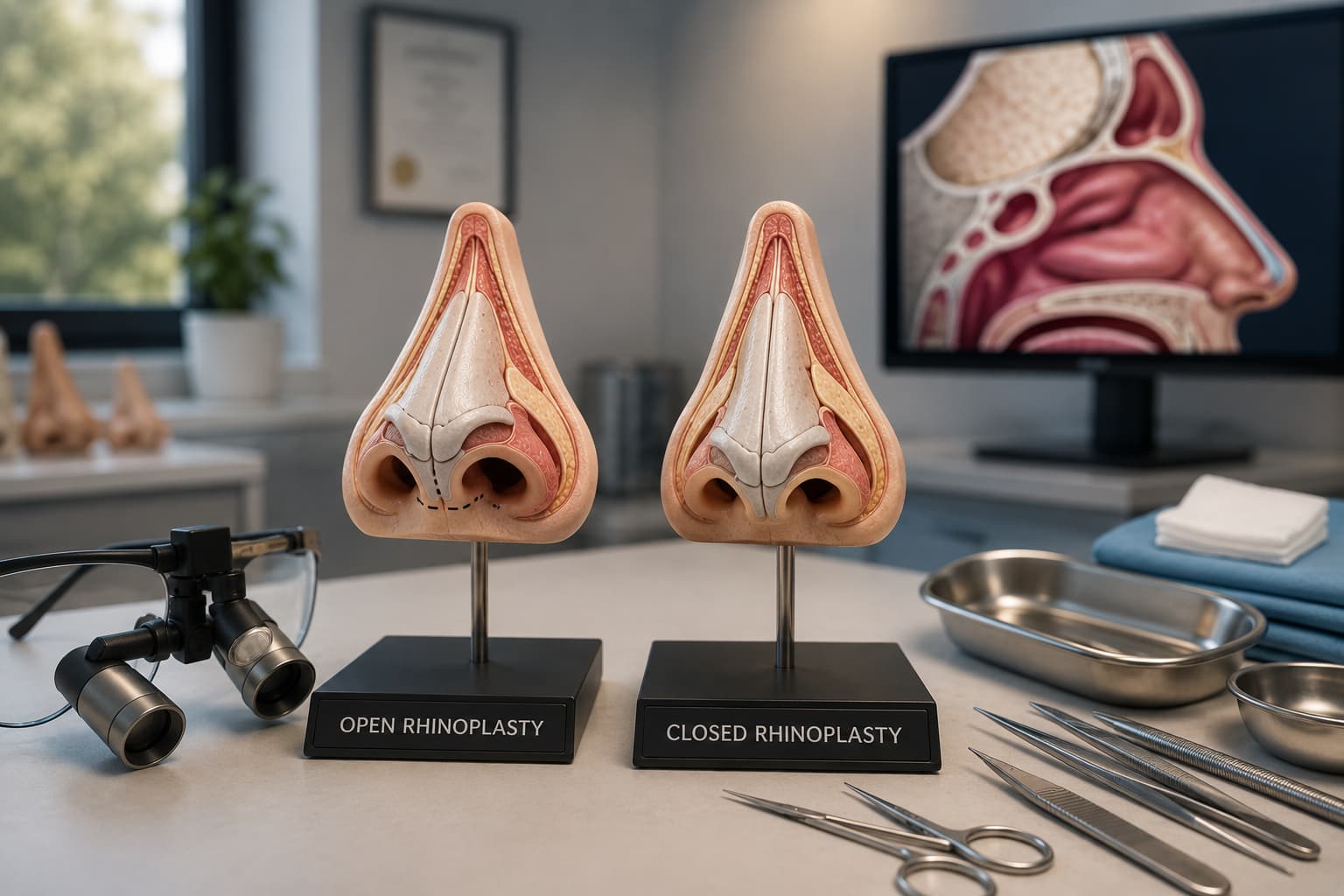
Patients researching rhinoplasty quickly come across two terms: open and closed. Both are well-established ways of reaching the structures of the nose. Neither is better in every case. The right choice depends on what needs to be changed.
What is closed rhinoplasty?
In closed (endonasal) rhinoplasty, all the incisions are made inside the nostrils, so there is no visible scar. The surgeon works through these internal openings to reshape the bone and cartilage.
- No external scar.
- Often less swelling in the tip, because the tip skin is not lifted.
- Well suited to more limited changes, such as reducing a dorsal hump or making modest tip adjustments.
What is open rhinoplasty?
In open rhinoplasty, a small incision is made across the columella (the strip of skin between the nostrils) and joined to incisions inside the nose. This allows the skin to be lifted so the surgeon can see the cartilage framework directly.
- Direct view of the tip cartilages and septum, allowing precise shaping and suturing.
- Easier placement and securing of cartilage grafts to support or rebuild the nose.
- Often preferred for complex tip work, crooked noses, revision surgery and reconstruction.
The columella scar usually heals to a fine line that is difficult to see once healed. Tip swelling can take longer to settle than after closed surgery.
So which is better?
The better approach is the one that gives your surgeon the access needed to achieve your goals safely and predictably. A small hump reduction may be ideal for a closed approach, while a nose needing significant tip support or grafting may need an open approach. Experience in both allows the technique to fit the patient, rather than the other way round.
How Mr Patel decides
At consultation, Mr Patel examines the outside and inside of your nose, including the septum and nasal valves, and discusses what you would like to change. He will explain which approach he recommends for you and why.
Learn more about the types of rhinoplasty procedures, or book a consultation.
Written by Mr Kalpesh Patel FRCS
Consultant ENT & Rhinoplasty Surgeon, London. Over 30 years of ENT surgical experience and more than 3,000 rhinoplasties performed.
This article is general information, not medical advice. Always follow the aftercare plan your surgeon gives you.
Considering surgery?
Talk through your options with Mr Patel
Book a consultationGet the free patient e-bookRelated articles

Male Rhinoplasty: What Men Need to Know

What Happens If My Rhinoplasty Needs Revision?

Rhinoplasty and Age: Is There a Right Time?

How Long Until I See My Final Results?