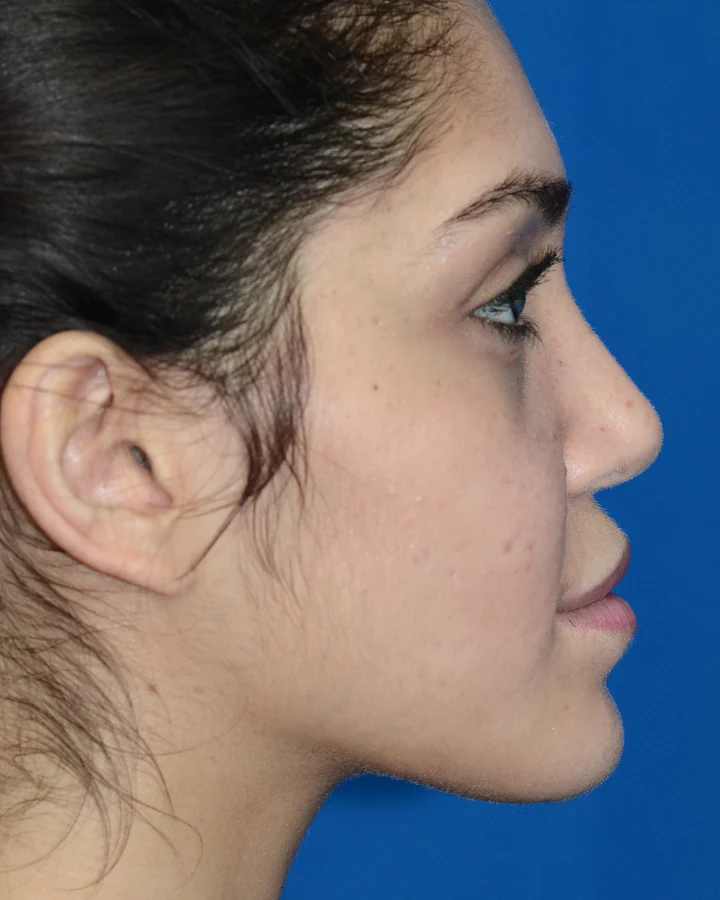
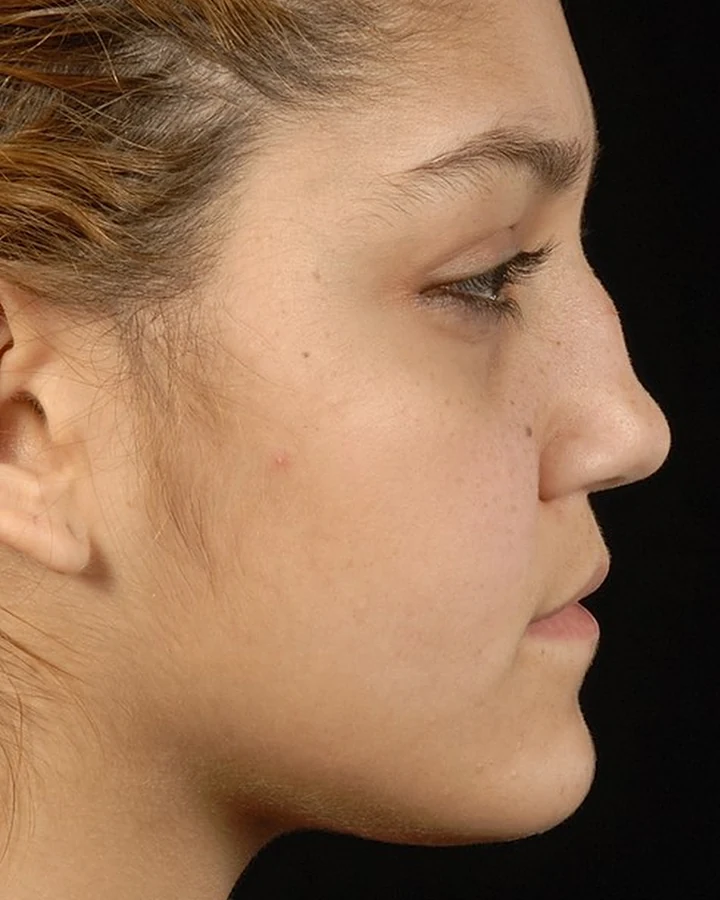
A saddle nose deformity describes a collapse or depression of the middle portion of the bridge, giving the nose a concave, or ‘scooped’, profile rather than a straight or gently curved one.
Before
After
The bridge of the nose relies on the septum for support from below. When part of the septum is lost or weakened, the middle of the bridge can sink, creating a dip between the bony upper part of the nose and the tip, and in more severe cases a shortened, upturned nose.
Because the septum provides central structural support for the whole nose, a saddle nose deformity is often more than a cosmetic concern - the same loss of support that causes the bridge to collapse can also affect the airway, particularly at the nasal valves.
A saddle nose most commonly results from loss of structural support in the septum - whether through injury, previous septal surgery in which too much cartilage was removed, or, less commonly, certain inflammatory conditions affecting the cartilage. It can also follow significant trauma to the nose itself. It is also seen after cocaine or other substance abuse.
A saddle nose is most noticeable in profile as a dip or “scoop” in the middle of the bridge. Because the same loss of support can affect the nasal valves, it is often accompanied by nasal blockage, which is assessed at the same consultation alongside any underlying cause.

Correcting a saddle nose deformity involves rebuilding the lost support along the bridge, typically using cartilage grafts to restore both the height of the dorsum and the structural integrity of the septum.
Saddle nose correction is usually carried out through an open approach under general anaesthetic. Support is rebuilt with cartilage grafts - from the septum where enough remains, or more often from the ear or rib - to reconstruct the septum and restore the height and line of the bridge. Where an inflammatory condition is involved, it is important that this is stable before surgery is planned.
Most visible bruising and swelling settle over the first few weeks, while the final shape continues to refine over around 12 months as residual swelling subsides - the nasal tip is usually the last area to settle. See Post Operative Care and Healing Journey and Final Results for what to expect at each stage.
If you are concerned about a saddle nose deformity, book a consultation with Mr Patel to discuss your options.
Personal consultation
Discuss your saddle nose deformity with Mr Patel
A one-to-one assessment of your nose, skin and breathing, with honest advice on what is achievable.
Book a Consultation 0207 262 0297Photographs show individual patients of Mr Patel. Results vary from person to person.
Every nose is different. Mr Patel will assess your anatomy in person and explain the options, recovery and realistic outcome.
Prefer to talk? Call 0207 262 0297